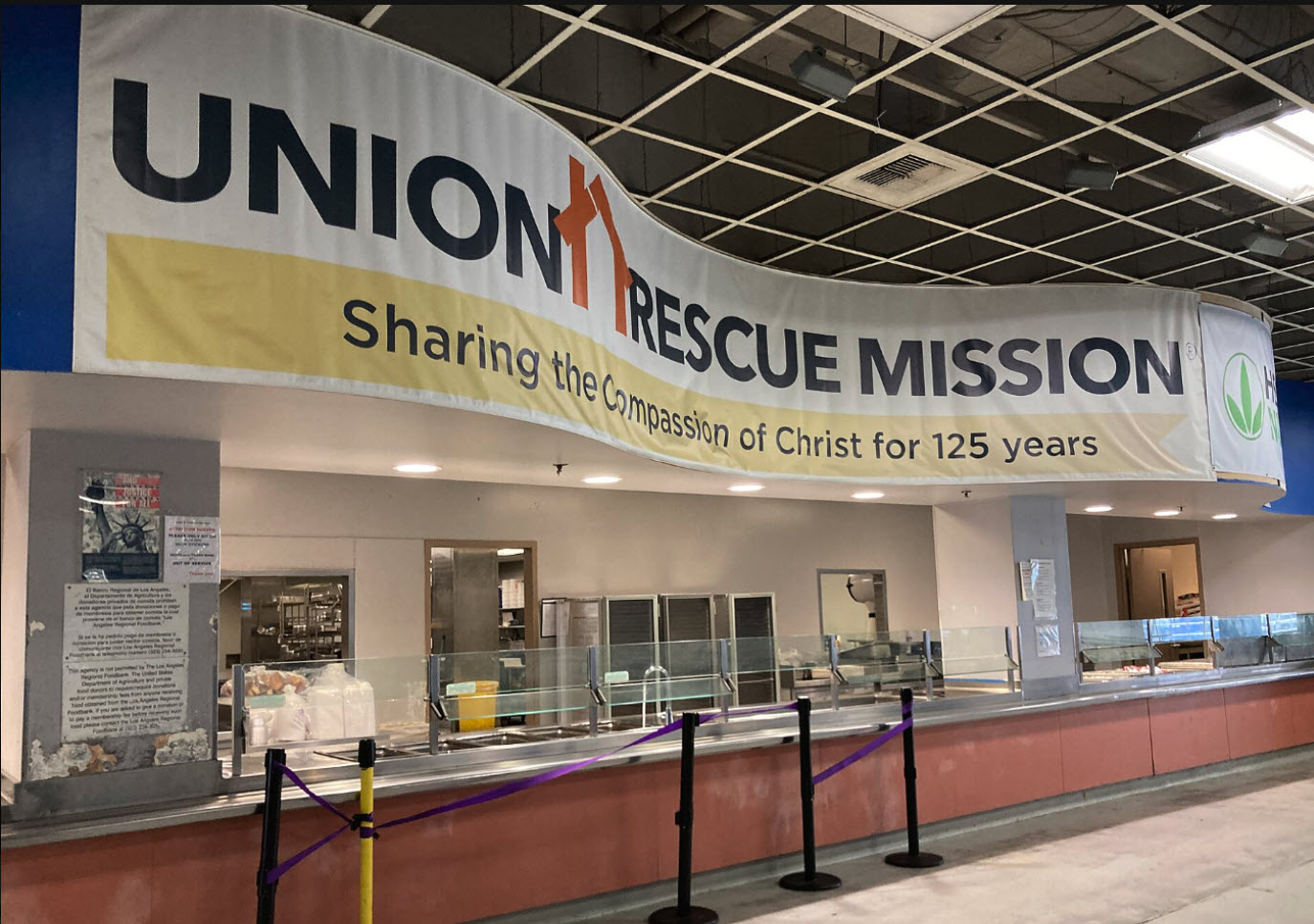
LOS ANGELES - The Union Rescue Mission has been assisting the homeless in downtown Los Angeles since its founding as the Pacific Gospel Mission in 1891 by Lyman Stewart, the President of Union Oil and a devout Christian Fundamentalist. 134 years later, it remains faith-based and service-focused. Its 30-year-old, 224,000 square foot facility on San Pedro Street, near Skid Row, shelters up to 1,000 people a night and features free health, dental, psychological, and legal-aid services courtesy of URM’s partnerships with local universities. Sobriety is mandated at all of URM’s facilities, including the two others in Sylmar and Willowbrook.
Mark Hood, who took over from Bales as CEO in September of last year, told us that, despite URM’s unabashedly Christian focus, “You don't have to be Christian to walk to our doors. We don't say no to anyone.” He described URM’s work as “two big buckets that we serve for the city. One is emergency services. People that walk through our door and they've lost an income, they've been evicted. They find themselves in need of shelter…and they may not be suffering from any addiction whatsoever. They just may find themselves in a desperate situation. They need some immediate help.
“Our other big bucket is more long-term care …and we're there to help them. We have people that come to us with an addiction… and for those groups of people, we have life transformation programs, which is a long-term approach…to deal with the trauma in their life, to deal with that addiction, and ultimately, help them find their way home
“Ultimately, the solution to homelessness isn't always just giving people shelter, because if you have someone that's experienced a lot of trauma in their life, or they're in an addicted state, and all you give them is shelter, then we really haven't addressed the root cause of why they're homeless to start with”.
According to Hood, URM is eager to partner with the city and county and recently did so at the behest of Mayor Bass, providing 53 beds to participants in the Inside Safe program “which isn’t much,” Hood said, “but that’s all the city asked for to begin with.” The participants were told in advance that, should they choose to go into URM, they would be in sober living and assigned case workers who would help find them a means of income and permanent housing. “We found permanent housing for over 50% of the men that have walked through our door,” Hood told us. “We have found jobs for some of those men. And what's even more exciting to us is those men are participating in our community.” According to the City Controller’s dashboard, fewer than 25% of all participants in Inside Safe had exited the program into housing as of April.
Hood’s previous job was overseeing large scale operations for an aerospace company, and he combines evangelical zeal with the kind of business experience needed to dramatically scale up URM’s operations. When asked what he thought of the recent chaos at LAHSA – the damning revelations from two different audits, the enormous expense of Inside Safe and the recent departure of LAHSA’s CEO -- he told us, “I come from the for-profit world, and they are simply driven and motivated to do things more efficiently year on year, because they want to be more profitable, they want to be more efficient, they want to get more done with less…I don't think that that same mindset is built into most government entities.”
As for the
results of LAHSA’s latest homelessness count, showing a countywide decline from 75,312 to 72,308, Hood was not particularly impressed. “If you had this big open field, and you put 75,000 people in that field, and you told everybody to close their eyes, and you changed it to 72,000, would anybody notice? Any improvement is a good improvement. But what I would say is that we as a community should expect more.”
On July 24, the Trump Administration issued an Executive Order on Homelessness which specifically called for the defunding of housing first and harm reduction programs and the prioritization of government grants to grantees who “adopt standards that address individuals who are a danger to themselves or others and suffer from serious mental illness or substance use disorder, or who are living on the streets and cannot care for themselves, through assisted outpatient treatment or by moving them into treatment centers or other appropriate facilities via civil commitment or other available means”. The EO was met with outrage and fear by many in the county’s homeless services sector. According to LAist, “Amy Perkins, homelessness advisor to L.A. County Supervisor Lindsey Horvath, said representatives with the Department of Housing and Urban Development recently indicated they might pull more homeless funding from L.A.” Perkins went so far as to say that “I think it's important to state that we met with HUD this week, with a Trump appointee who made very clear that he would recommend there would be no funding coming to our city”.
However, Hood told the Current that he met with Scott Turner, the current Secretary of Housing and Urban Development, shortly after the inauguration in January, and came away with a much different impression. “He said that HUD wants to begin partnering with faith-based organizations that have a track record of success. And the regional HUD team that's responsible for this area has visited as well and said, ‘you know, we need to look at ways that we can collaborate without changing who you are.’ Where there is funding available, where we don't have to compromise our core values, and that allows us to help more people with the model that we've built, then we absolutely welcome those collaborations.”
Despite being the possible beneficiary of this changing political climate, Hood frowns on politicizing the issue of homelessness. “I have tried very hard to be non-political in the way I approach things, because I truly do believe that we have to come together as a community, and if we keep, as a nation, politicizing every single topic...that progress is always Just going to be stunted and impeded.”
Ultimately, for Hood, radical success – 20 or 25% decreases in the number of people living on our streets, rather than the mere 4% the city managed last year – comes down to “finding a model that works…if we look at all the funding that we have spent as Angelenos, over the past couple of years towards solving homelessness, only to see the numbers change from 75,000 to 72,000 and we took that money and we said, ‘okay, we don't need one Union Rescue Mission. We need ten. We want to multiply that model so that we have ten of those models across the city and strategic locations, and we're going to fund that model for the next three years.’
“If we look at the money we spent the last two years, that's an easy investment. And all of a sudden, instead of having one thousand people under the roof that you're helping, you have 10,000 people under the roof on any given night.”